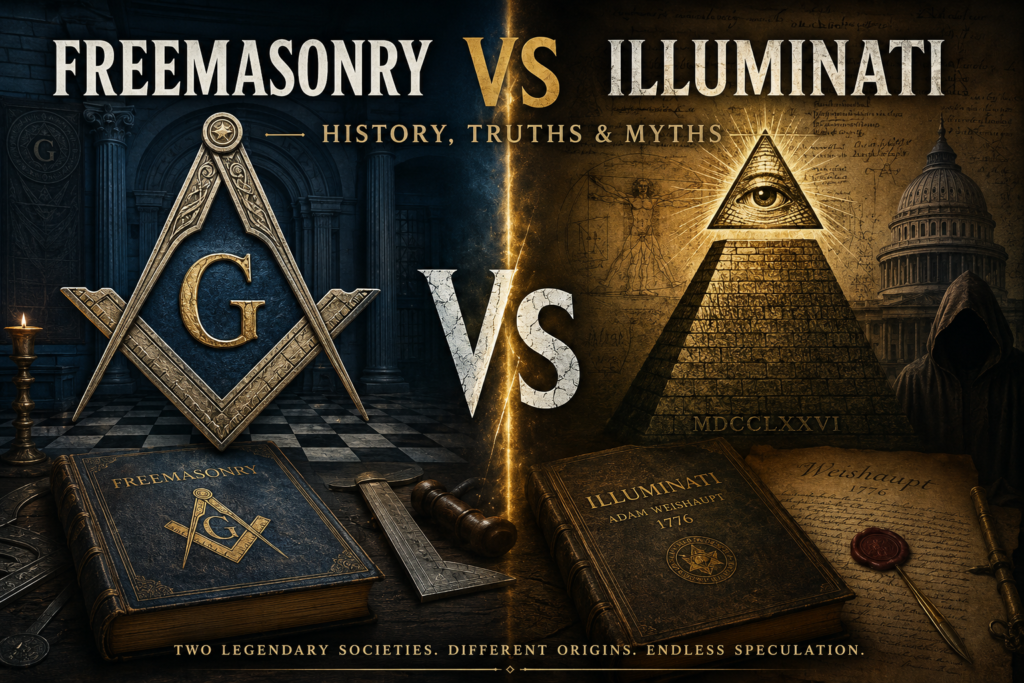
Freemasonry vs Illuminati: Separating History from Myth: For centuries, the names “Freemasonry” and “Illuminati” have sparked fascination, mystery, and conspiracy theories across the world. Some people believe these groups secretly control governments, banks, and world events. Others see them as misunderstood organizations wrapped in centuries of speculation and legend.
But what exactly are the differences between Freemasonry and the Illuminati? Are they connected? And why have both become symbols of secrecy and power in popular culture?
Freemasonry vs Illuminati: Separating History from Myth.
What Is Freemasonry?
Freemasonry is one of the world’s oldest fraternal organizations. Its roots trace back to the stonemason guilds of medieval Europe, particularly during the 16th and 17th centuries. Over time, it evolved into a social and philosophical brotherhood focused on morality, personal growth, charity, and fellowship.
Freemasonry is organized into local groups called lodges, where members participate in ceremonies, discussions, and charitable activities. The organization uses symbols such as the square and compass, which represent moral discipline and ethical behavior.
Core Principles of Freemasonry
Freemasonry promotes values such as:
- Brotherhood
- Charity
- Truth
- Integrity
- Self-improvement
Members often come from different religions, professions, and political backgrounds. Contrary to popular belief, Freemasonry is not officially a religion or a political movement.
What Is the Illuminati?
Bavarian illuminati was a real secret society founded in Bavaria (modern-day Germany) in 1776 by Adam Weishaupt, a professor of law. The group aimed to challenge superstition, religious influence over public life, and abuses of political power during the Age of Enlightenment.
Unlike Freemasonry, the Illuminati existed for only a short period. The Bavarian government banned the organization in the late 1780s, and historians generally agree that the original group disappeared soon afterward.
Goals of the Illuminati
The original Illuminati promoted:
- Rational thinking
- Secularism
- Intellectual freedom
- Resistance to oppressive authority
However, over the years, the Illuminati became the center of countless conspiracy theories claiming it secretly survived and now controls global politics, finance, entertainment, and media.
Freemasonry vs Illuminati: Key Differences
| Feature | Freemasonry | Illuminati |
|---|
| Origin | Medieval Europe | Bavaria, 1776 |
| Nature | Fraternal organization | Secret political society |
| Status Today | Still active worldwide | Historically dissolved |
| Main Focus | Morality, charity, fellowship | Enlightenment ideals and reform |
| Public Presence | Lodges, public charities | Mostly tied to conspiracy theories |
| Membership | Broad social membership | Historically exclusive and secretive |
Why Are They Often Confused?
The confusion between Freemasonry and the Illuminati largely comes from secrecy and symbolism. Both groups used rituals, coded language, and private meetings, which naturally fueled public curiosity.
Additionally, some members of the Bavarian Illuminati reportedly infiltrated Masonic lodges during the 18th century to recruit educated and influential individuals. This historical overlap helped create the lasting assumption that the two organizations were deeply connected.
Modern conspiracy theories amplified these beliefs even further.
The Role of Pop Culture
Movies, music videos, internet forums, and social media have transformed the Illuminati into a global cultural phenomenon. Celebrities are frequently accused of being members based on symbolic gestures, fashion choices, or visual imagery.
Meanwhile, Freemasonry often appears in films and novels as a mysterious brotherhood guarding ancient secrets. Books like The Lost Symbol helped revive mainstream interest in Masonic lore.
Despite the entertainment value, much of the modern narrative mixes historical facts with fiction and speculation.
Common Myths About Freemasonry and the Illuminati
Myth 1: They Control the World
There is no credible evidence proving that Freemasonry or the Illuminati secretly controls governments or global economies.
Myth 2: Freemasonry Is the Same as the Illuminati
Although the two groups briefly intersected historically, they were different organizations with different goals.
Myth 3: All Their Activities Are Secret
Freemasonry is relatively public today. Many lodges have official websites, charity programs, and public buildings. The secrecy mostly relates to rituals and traditions.
Myth 4: The Illuminati Still Exists as Originally Founded
Most historians believe the original Bavarian Illuminati ended in the late 18th century.
Why People Are Fascinated by Secret Societies
Human beings are naturally drawn to mystery. Secret societies create intrigue because they combine:
- Hidden knowledge
- Symbolic rituals
- Elite membership
- Historical influence
In uncertain times, conspiracy theories also offer simplified explanations for complex global events. This is one reason the Illuminati myth remains powerful even centuries after the original organization disappeared.
Final Thoughts
Freemasonry and the Illuminati are often linked together in public imagination, but history tells a more nuanced story. Freemasonry is a long-standing fraternal organization focused on brotherhood and personal development, while the Illuminati was a short-lived Enlightenment-era society aimed at political and intellectual reform.
The legends surrounding both groups continue to grow through pop culture, conspiracy theories, and internet speculation. Yet separating historical fact from fiction is essential for understanding why these names still capture global attention today.
Leave a Reply